Street life in Danzhou (photographed on site, collected October 2026)
In Hainan, asking "Do you speak Hainanese?" is an easy question to get wrong — because Hainan has more than one dialect.
The official introduction on the Hainan Provincial People's Government website contains one line: Hainan residents use many languages, and the main dialects number 10. Ten — and they don't all belong to the same language family.
Even more counterintuitive is this: the Danzhou dialect belongs to the Cantonese dialect system. Danzhou is the city where Haihua Island is located. In other words, the dialect you hear on Danzhou's streets is not the same thing as the "Hainanese" you hear in Haikou and Wenchang.
All ten in one table
Compiled from public materials of the Hainan Provincial People's Government website:
| Dialect | Classification | Speakers | Main distribution |
|---|---|---|---|
| Hainanese | Southern Min dialect | Over 5 million | Haikou, Qiongshan, Wenchang, Qionghai, Wanning, Ding'an and elsewhere; the Wenchang accent is the standard |
| Lingao | Kam-Tai (Zhuang-Dong) branch, Zhuang-Dai group, close to Zhuang | About 500,000 | Lingao County and the western suburbs of Haikou |
| Hlai | Hlai branch of the Kam-Tai family | Used by the Hlai people across the province | Autonomous counties of the central and southern regions |
| Danzhou dialect | Cantonese dialect system | Over 400,000 | Coastal Danzhou, Changjiang and Dongfang |
| Junhua | Southwestern Mandarin of the northern dialect system | Over 100,000 | Parts of Changjiang, Dongfang, Danzhou and Sanya |
| Miao | Hmong-Mien (Miao-Yao) family | Tens of thousands | Central and southern regions |
| Cunhua | Kam-Tai family, close to Hlai | About 60,000 | Dongfang and both banks of the lower Changhua River in Changjiang |
| Mai | Cantonese dialect, close to Guangzhou speech | Not many | Yacheng and Shuinan in Sanya |
| Danjia | Cantonese dialect | — | Coastal Lingshui, Sanya, Changjiang and Haikou |
| Huihui (Tsat) | Austronesian family (Chamic branch, cognate with the Cham language of Vietnam) | Over 10,000 | Huihui and Huixin villages in Sanya |
One island, ten dialects, spanning six systems: Min, Cantonese, Kam-Tai, Hmong-Mien, Southwestern Mandarin, and Austronesian.
Why such a mix
Because Hainan is an island of migrants. More than three thousand years ago, a branch of the ancient Baiyue people crossed the Qiongzhou Strait from Guangdong and Guangxi — the ancestors of today's Hlai. Later, Han, Miao and Hui people migrated in one after another, each wave from a different time and place bringing its own mother tongue.
- From southern Fujian: "Hainanese" in the narrow sense is a Southern Min dialect and retains many classical Chinese words — rice is "he," rope is "suo," face is "mian," chopsticks are "zhu," to walk is "xing," and to run is "zou."
- Back from Southeast Asia: Hainan is one of China's key hometowns of overseas Chinese, with more than 3.9 million Hainanese living abroad as overseas Chinese and compatriots in Hong Kong and Macao, across more than 60 countries and regions.
- Soldiers and officials: they left behind "Junhua," part of the Southwestern Mandarin system.
- Even older: Lingao and Cunhua both belong to the Kam-Tai family, a different system from Chinese.
The most special is Huihui. It is not Chinese at all, nor does it belong to the Sino-Tibetan family. The Hainan Provincial People's Government website now states that "academics consider it part of the Austronesian family" — its speakers descend from Cham people who migrated from Champa (present-day central and southern Vietnam) during the Song and Yuan dynasties, and their language is cognate with today's Cham. It is the only one of the ten that is outside Sino-Tibetan and connected to Southeast Asia.
The special case of Danzhou
The Danzhou dialect belongs to the Cantonese dialect system and is spoken by more than 400,000 people, mainly along the coast of Danzhou, Changjiang, Dongfang and other cities and counties. So in the area where Haihua Island sits, the locals speak a Cantonese-system tongue.
But this classification needs a footnote, to be precise: "belonging to the Cantonese dialect system" is the classification used in public materials of the Hainan Provincial People's Government website, and the 1996 "Danzhou County Gazetteer" classified it the same way. Yet linguists are not unanimous — the "Language Atlas of China" (2nd edition) holds that the Danzhou dialect is hard to classify and lists it separately as "unclassified non-Mandarin." So the more accurate statement is: the government's official position puts it in the Cantonese system, while the academic classification remains unsettled. The speaker count also has two versions: the provincial government website records over 400,000, while field surveys by linguists such as Zhang Huiying estimate about 700,000.
The traces dialects leave behind
Dialects are not just a way of speaking; they live on in place names, dish names and forms of address. Take "drinking tea" — when Hainanese people greet each other, they say "de xian chi cha" (得闲吃茶): "have tea when you're free." Even when whizzing past an acquaintance on an e-bike, they'll toss out these four words. It's not just an invitation to tea; it's a way of saying hello.
Hainan is not large, but its linguistic layers run deep. Southern Min, the Cantonese system, Kam-Tai, Southwestern Mandarin, Hmong-Mien — and Huihui, which doesn't belong to Sino-Tibetan at all. Separated by the strait and the mountain ranges in the island's center, they have each survived on their own. When you come to Danzhou, what you hear may be completely different from what you hear in Sanya. It's not that anyone speaks wrong — it's that this island can hold many different origins. And it's fine if you can't understand. When someone says "de xian chi cha" to you, you'll know what it means: when you're free, sit down for a while.
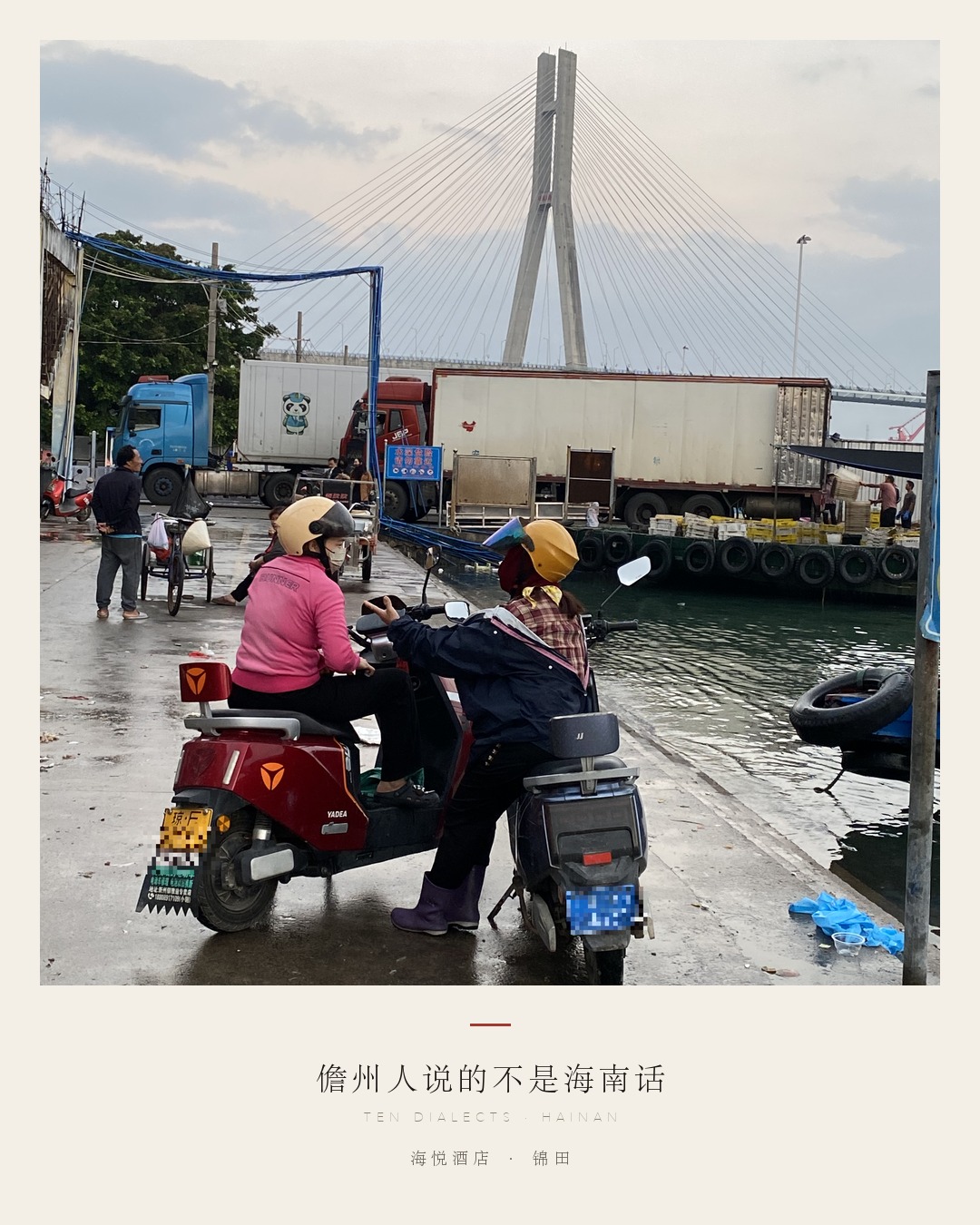
Hainan Danzhou · Haihua Island
Tel 0898-23509960