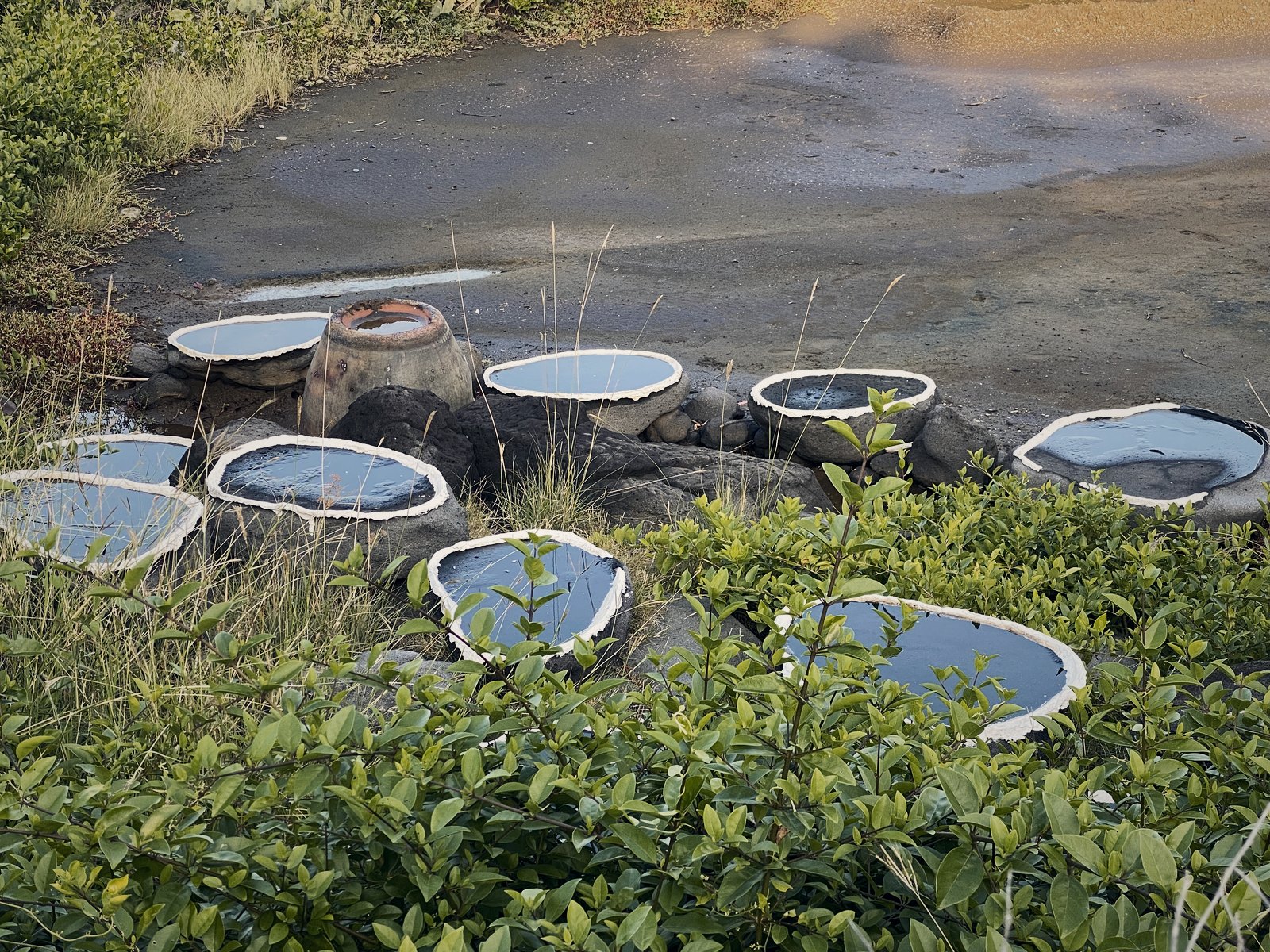
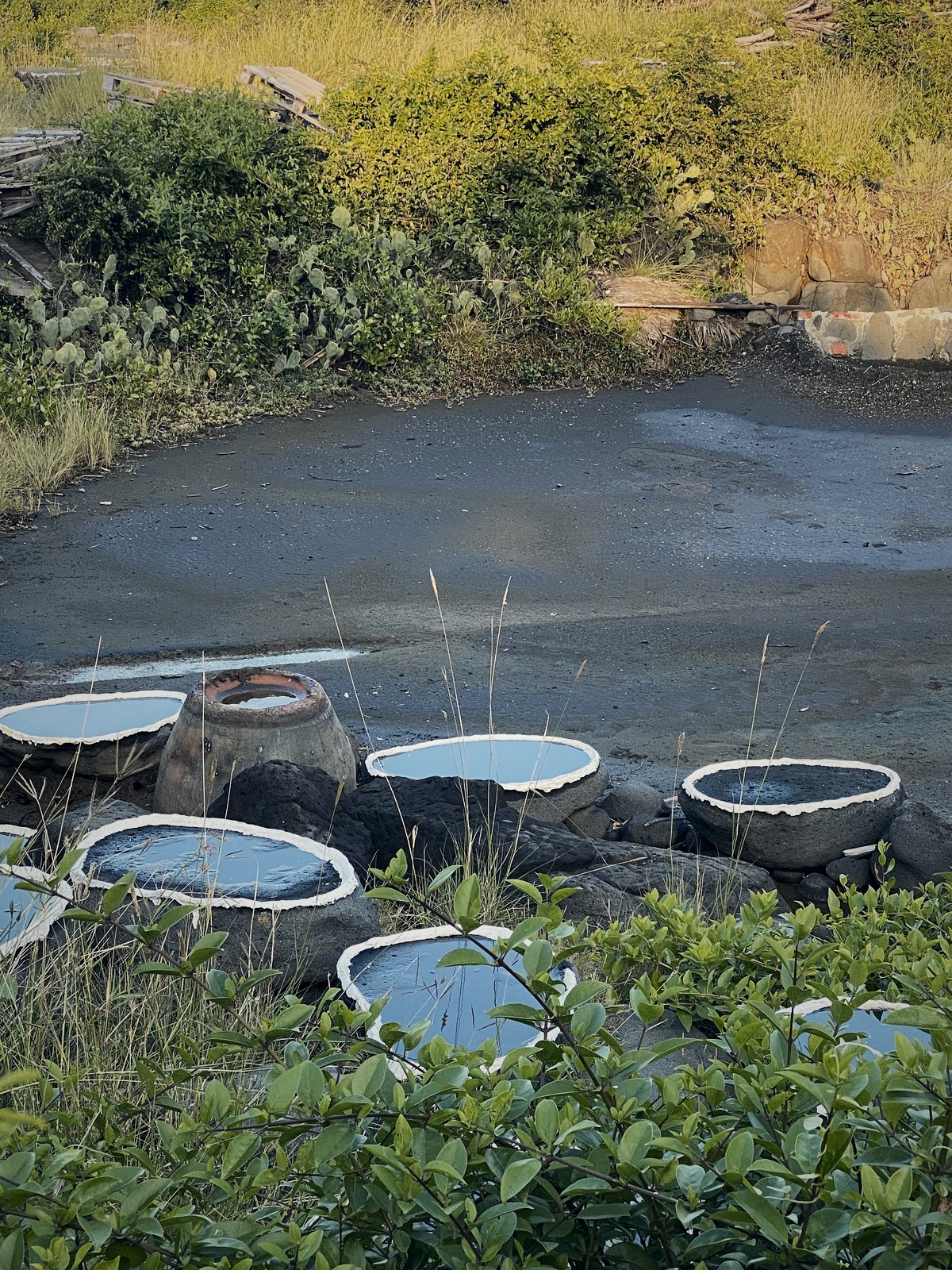
Yantian Village, Yangpu · inkstone-shaped stone salt troughs (on-site photo, October 2026)
Most "thousand-year ruins" are reduced to stone.
This place is different.
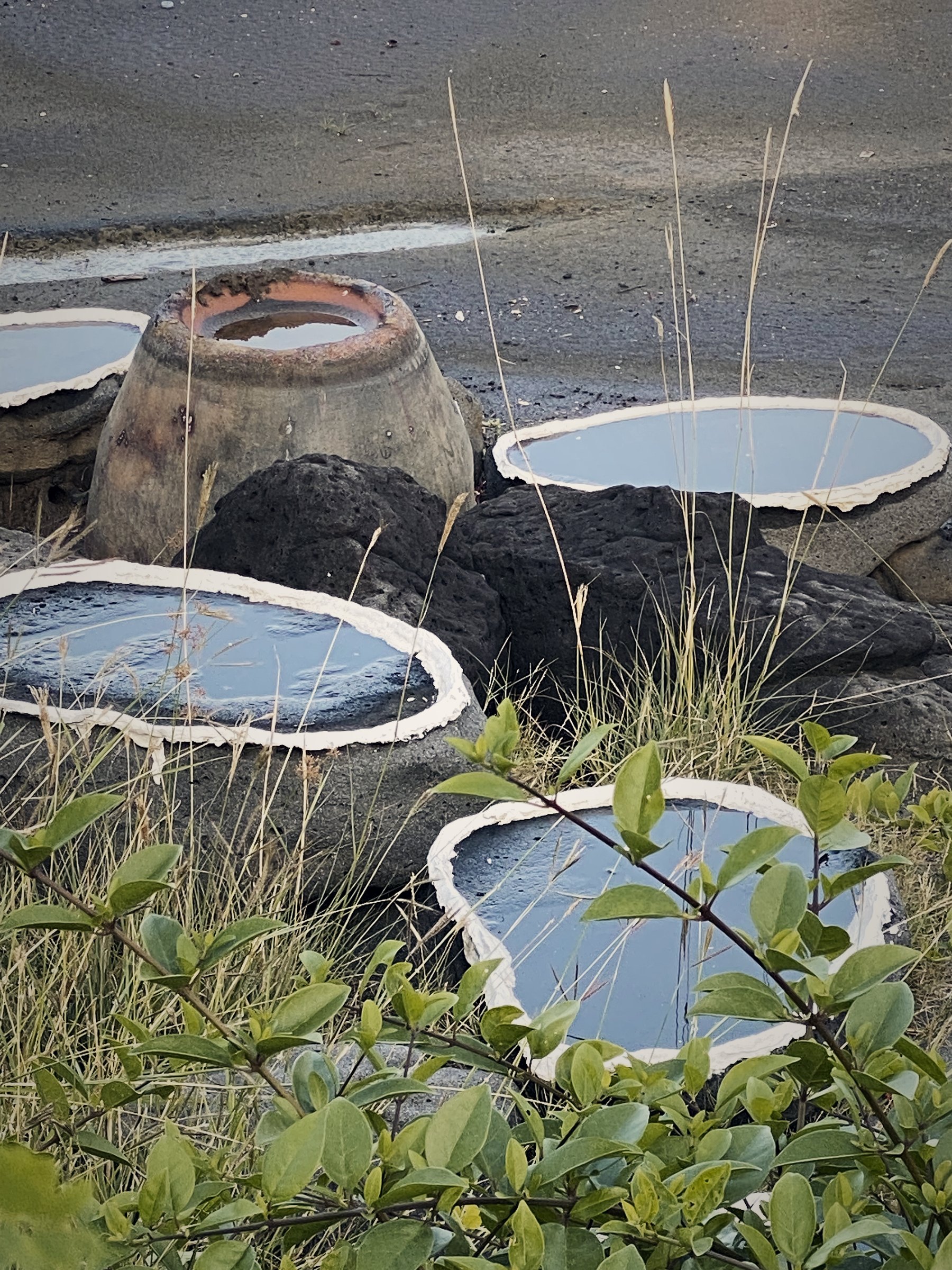
In Yantian Village in Yangpu, Danzhou, thousands of stone troughs lie scattered along the shore like so many inkstones, packed densely around the salt fields. They were carved into volcanic rock more than twelve hundred years ago.
Public records say more than thirty salt-making households still work here every day, using the same ancient method.
On the October day we visited, there was no one in the salt fields.
No one pouring brine, no one harvesting salt. Thousands of troughs lay still on the volcanic rock, dry inside.
How it makes salt
Not by boiling — by drying in the sun.
Roughly, the process goes like this:
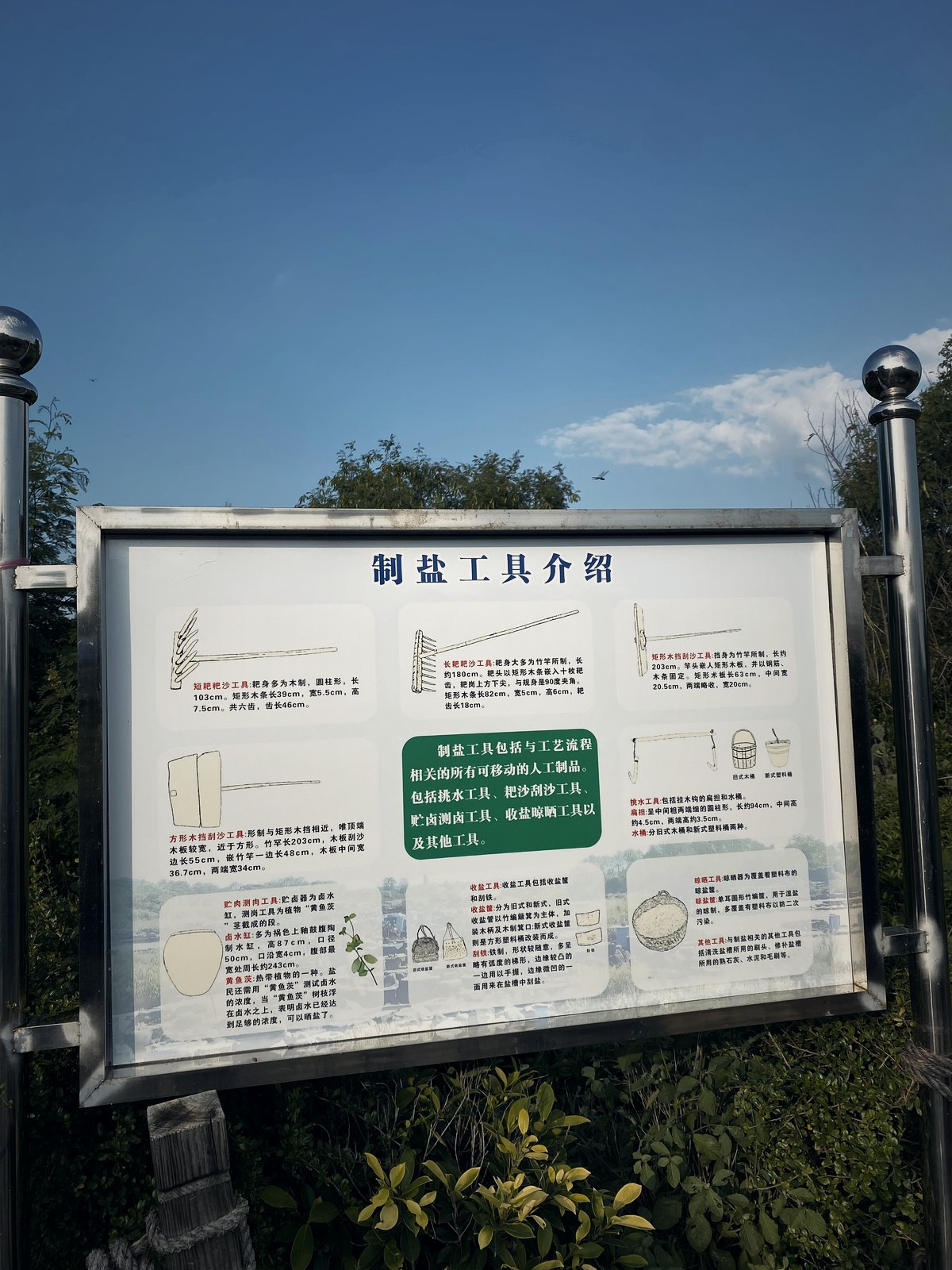
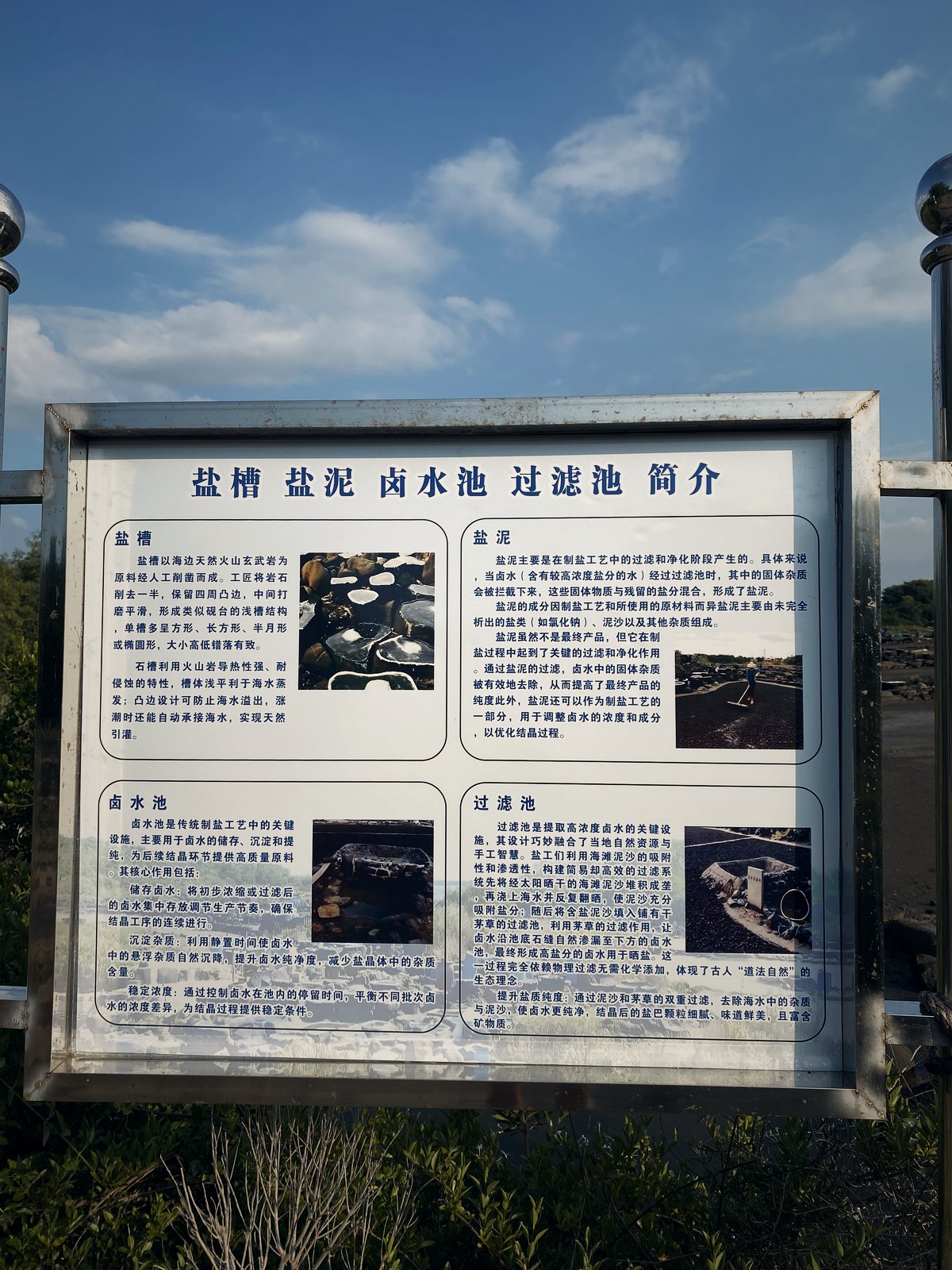
First, the sand and silt on the beach is dried in the sun, then doused with seawater and filtered — yielding a highly saline brine. The brine is poured into the stone troughs and left to the blazing sun; the water evaporates and the salt remains.
It sounds simple, but this method is called solar salt-making, and this is one of the earliest solar salt-making sites in China.
More precisely, it is the last ancient salt field in China still using the original solar method.
Elsewhere the technique changed long ago. Not here.
The troughs have a distinctive shape: raised edges with a sunken center, like an inkstone — hence the name "inkstone-shaped stone salt trough." The material is volcanic rock; this stretch of Danzhou is a volcanic-rock coast, so the stone came from right here.
One rule to remember: never step on the salt troughs.
They aren't decorative props. For twelve hundred years they have been working tools. Step on one and you break it.
When to go and what to see
The salt fields are open all day, free of charge, no reservation needed, with free parking at the village entrance.
Don't count on seeing anyone making salt. A Ctrip travel tip says "to see salt workers at work you generally need to go in the evening,"
We went at that hour and saw no one either.
So what's really worth choosing is the light:
| Time | What you'll see |
|---|---|
| Dusk to sunset | The best light. The troughs in backlight/side backlight — the most photogenic moment here |
| After 4 pm | Slanting light appears and the troughs gain dimension |
| Midday | Harshest sun, flat light, hard to shoot — but the fewest people |
Allow about 1.5 hours.
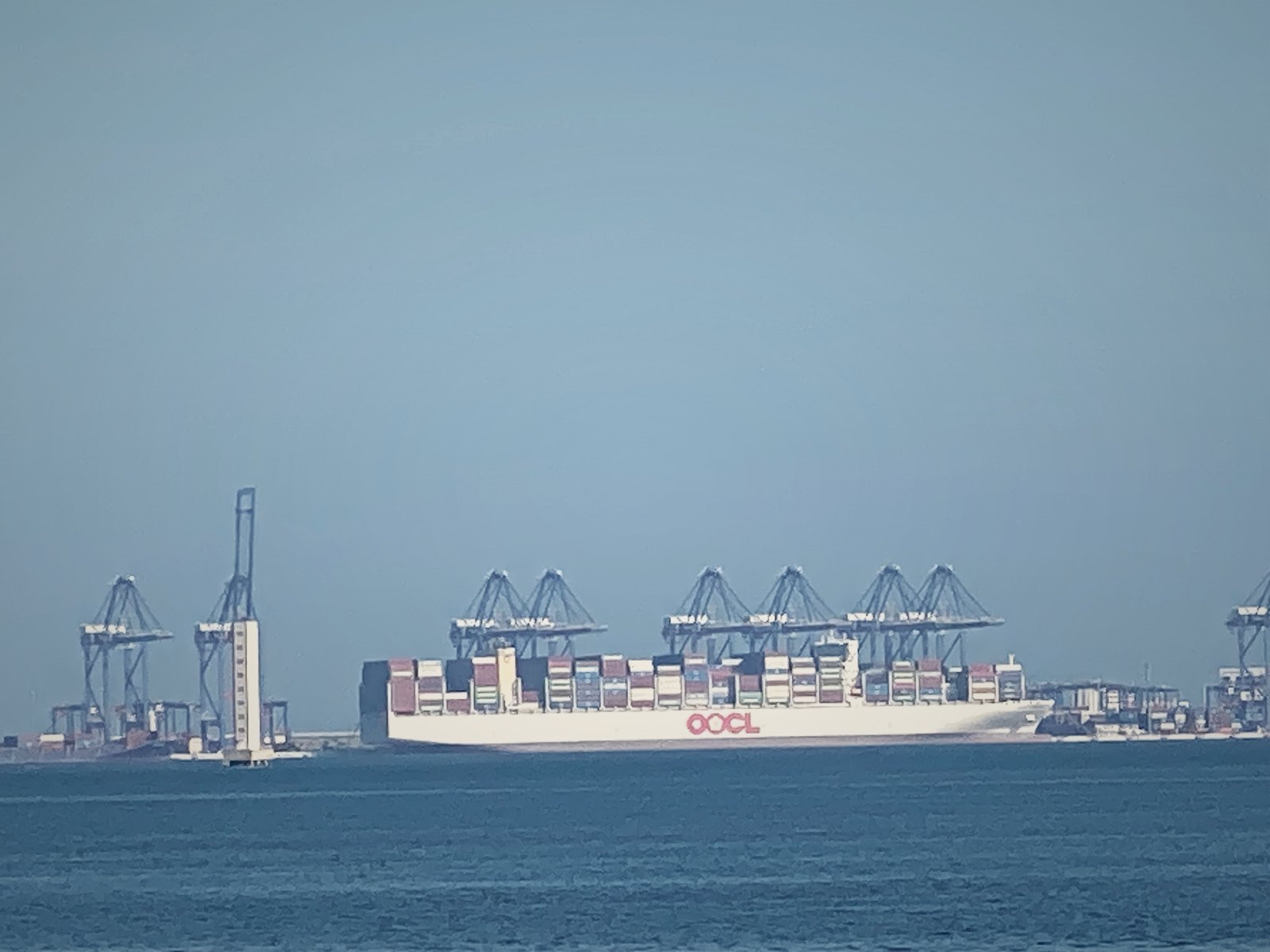
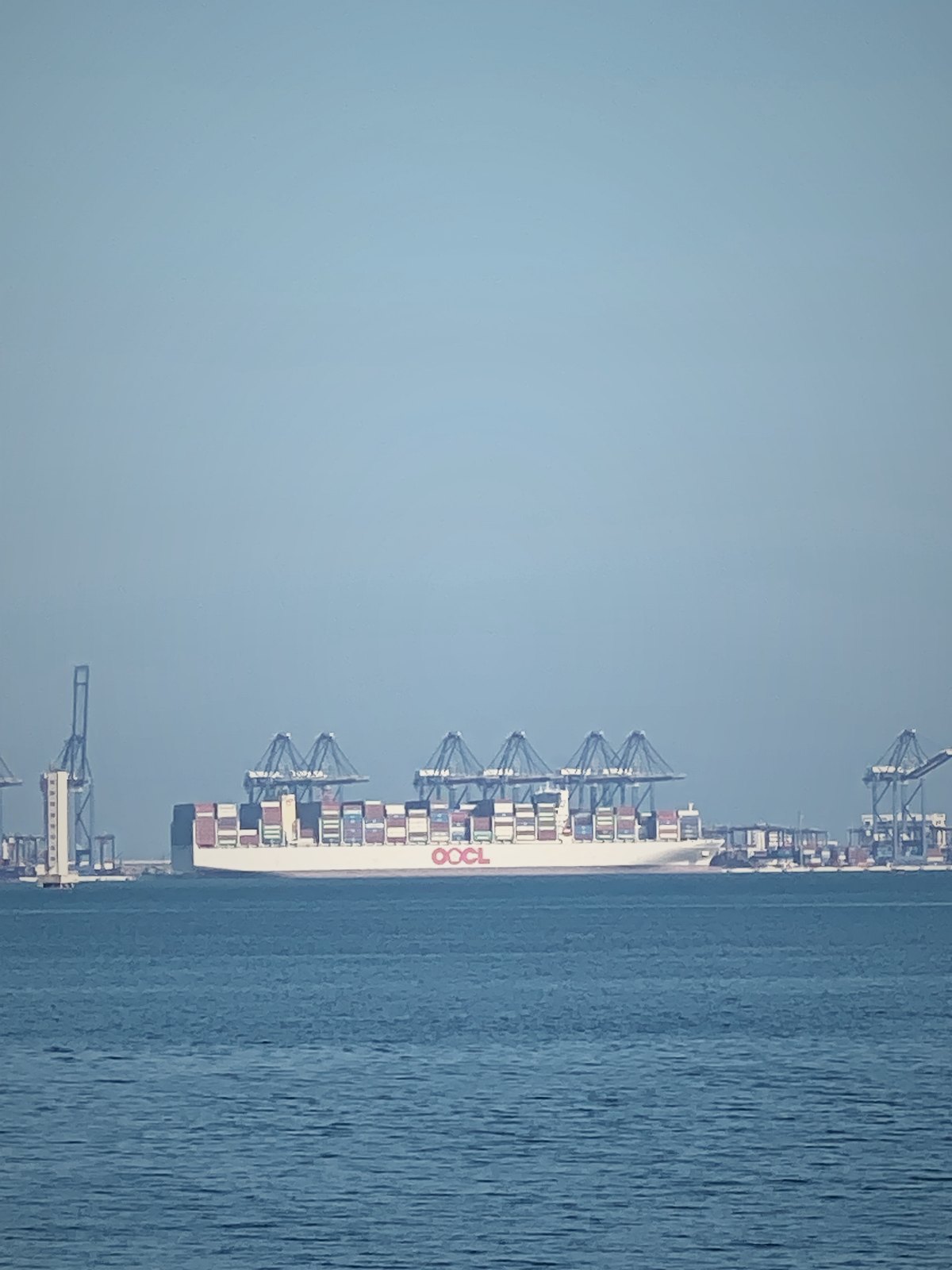
The village has a viewing platform overlooking the whole salt field. From up there, the troughs look like a chessboard laid across the earth. In the distance is Yangpu Port, with cargo ships from many countries at anchor.
A twelve-hundred-year-old hand-worked salt field and a modern container terminal, in the same frame.
Beyond salt, what to eat
There are vendors in the village and at its entrance.
Salt-baked chicken. A chicken is wrapped tightly in several layers of paper and buried in heated salt to cook. About RMB 50 each (price subject to on-site), and you can unwrap and eat it right there.
Salt-baked eggs. Both chicken and duck eggs.
Aged salt. Five to ten yuan a bag, easy to take home. Salt dried from these fields is the most direct souvenir here.
Sandworm. Not from Yantian Village but from Guangcun in Danzhou — a marine creature living in coastal mudflats, locally called "marine cordyceps." It works boiled, salt-and-pepper style, or in congee.
Dried red snapper. The dried red snapper of Xinying is another treat, excellent in claypot rice.
Why here
Step back and ask: why would salt fields be on Hainan's west side, not the east?
Because making salt by sun needs sun.
Across central Hainan runs a chain of mountains — Wuzhishan, Limu Ridge, Bawangling — running southwest to northeast. The summer monsoon, heavy with moisture, makes landfall in the east, hits the mountains, is forced upward, and rains. Once over the peaks, the air sinks westward with little moisture left.
So the east gets over 2,400 mm of rain a year, the west under 900, yet with high evaporation.
The west is semi-arid.
For farmers it's a disadvantage. For salt-makers it's a gift — strong sun, little rain, fast evaporation.
These salt fields have lasted twelve hundred years not because the people here are especially tenacious, but because the sun here is especially suited to the work.
(By the way, this is also why the west is ideal for sun-loving, drought-tolerant crops like mangoes, dragon fruit and Hami melons. Hainan's prime off-season fruit and vegetable region lies mainly in the west.)
It's more than a relic
The sea-salt sun-drying technique here is on the intangible cultural heritage protection list.
And these salt fields are the vessel of that craft — not a recreated exhibit but a working site genuinely used for over a thousand years.
This is its biggest difference from "ruins" elsewhere: elsewhere a ruin is something left behind, but here is a place where things happened.
The movement a person made twelve hundred years ago, bending over these troughs, is the same one every salt worker since has made. It's just that on the day we went, the movement was paused.
Finally
An inkstone-shaped stone trough, carved into volcanic rock, worked by seawater and sun for twelve hundred years.
It hasn't yet turned into a tourist attraction. As for whether salt is still made here — on the day we were there, the answer was no.
When you go, remember two things: don't step on the troughs, and ask before photographing people.
The rest is just waiting for the sun to set and watching those troughs turn gold.
Hainan Danzhou · Haihua Island
Tel 0898-23509960