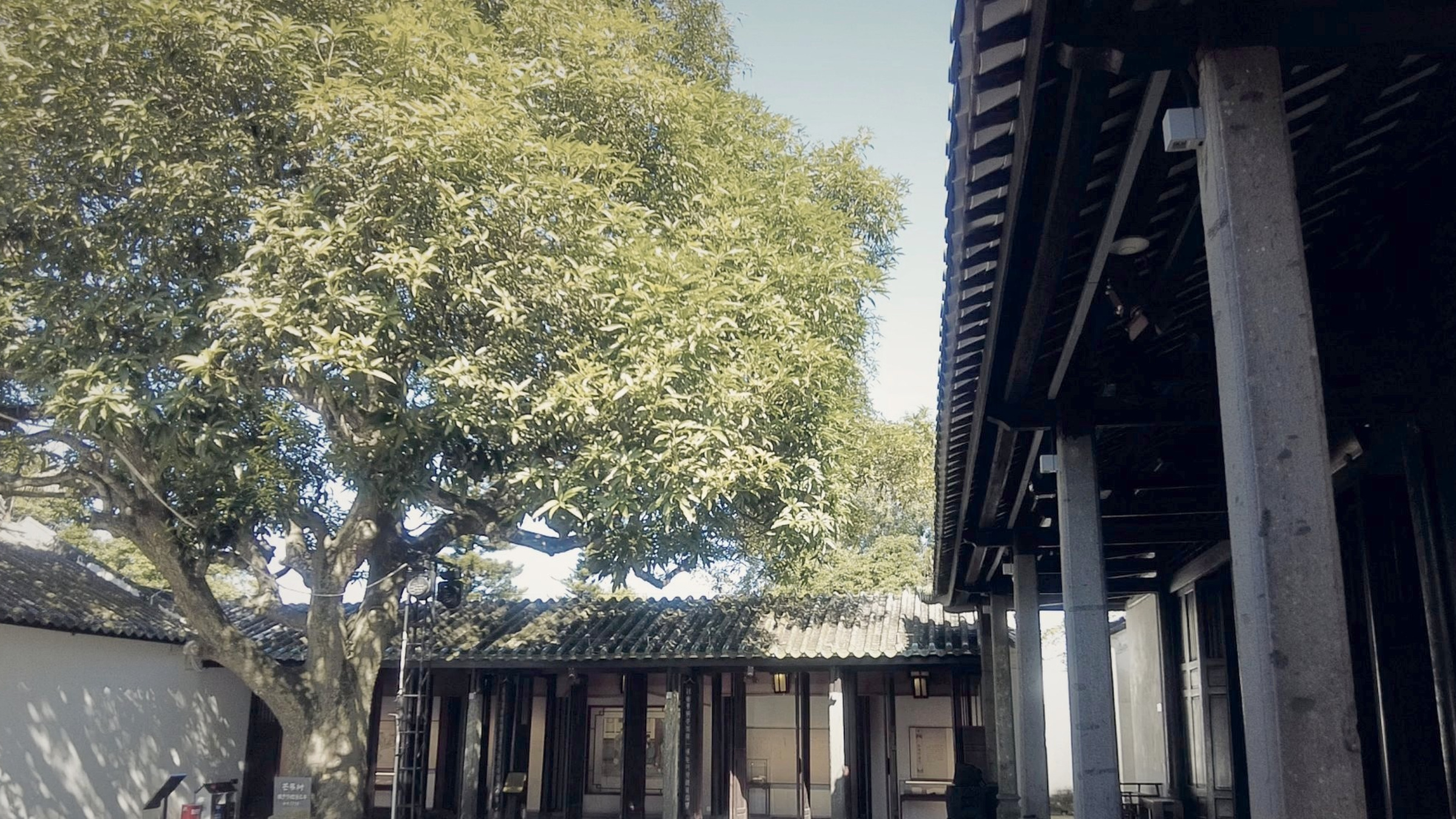
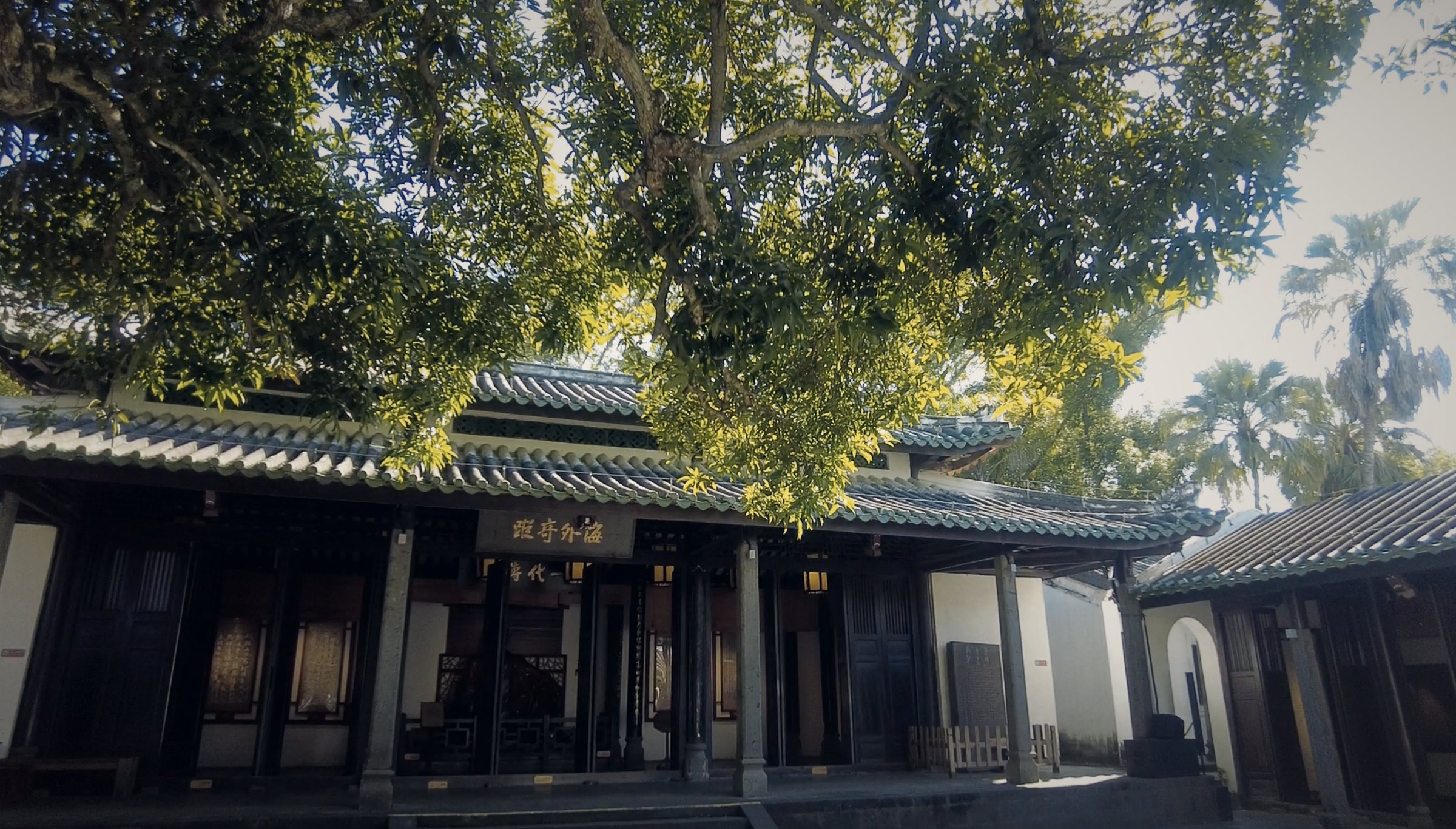
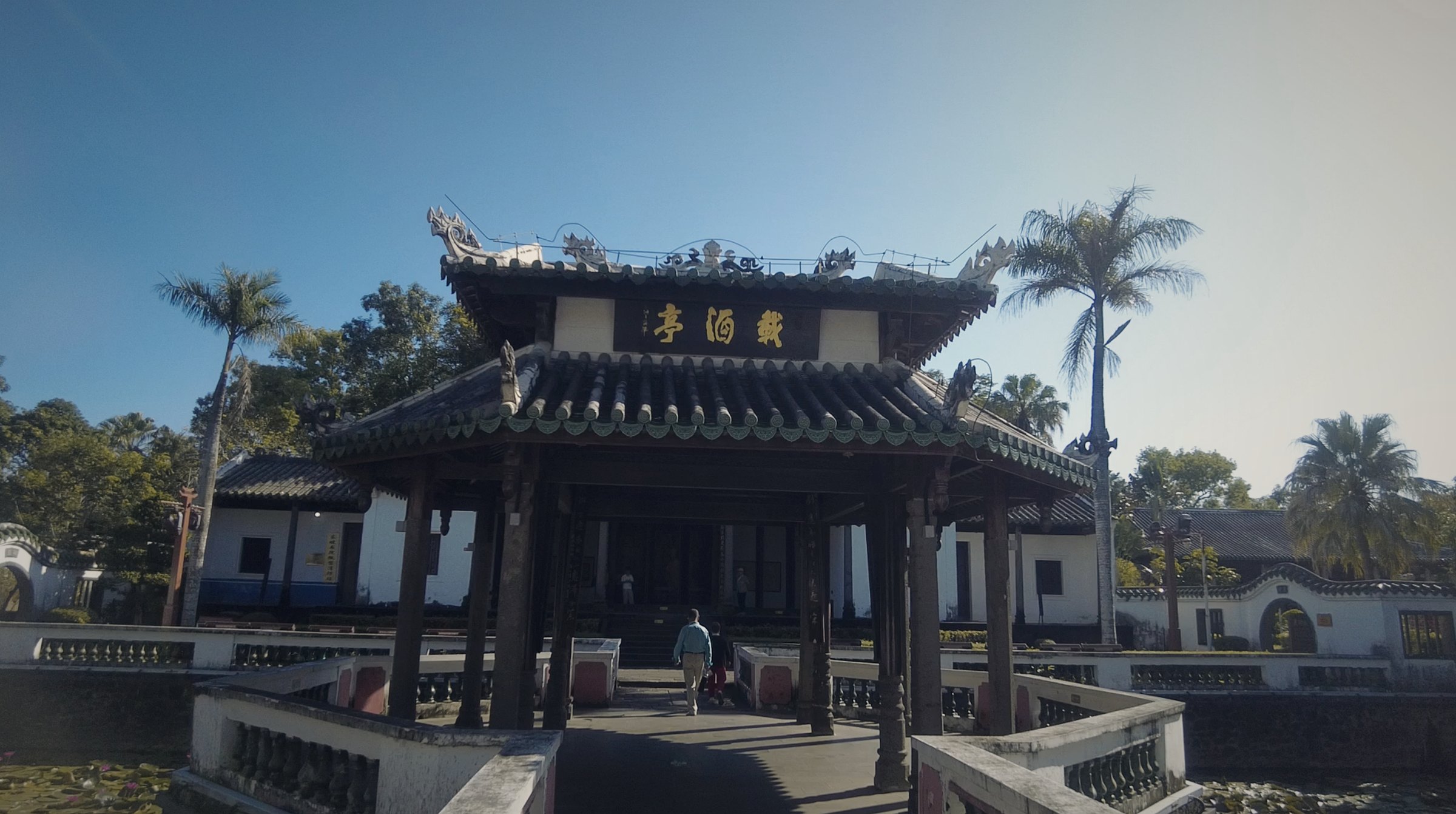
Danzhou · Dongpo Academy (on-site photo, October 2026). This piece covers the west route; the desert and coast are pending on-location photography.
There is a desert in Hainan. By the sea.
Not a figure of speech. Around Qizi Bay in Changjiang, bare sand stretches for six kilometers. Farther south, toward Sigeng, Luodai and Gan'en in Dongfang, the sand runs in broad patches too.
This is the only place in China where you can see a tropical desert landscape.
Most people don't know this. Say "Hainan," and they think of coconut groves, beaches, rainforest, downpours — the east and south of the island. But the same island looks different once you reach the west.
How big is the difference? One number says it all.
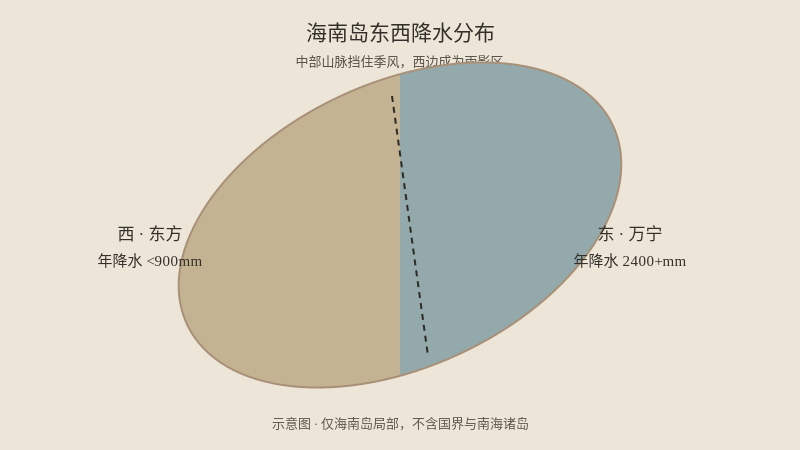
Wanning gets over 2,400 mm of rain a year. Dongfang gets less than 900.
On the same island, a difference of almost threefold.
One mountain range splits the island in two
The reason lies not on the coast but in the middle of the island.
Across the middle of Hainan runs a chain of mountains: Wuzhishan, Limu Ridge, Bawangling. They run southwest to northeast, squarely in the path of the monsoon.
The summer monsoon sweeps in from the Pacific and Indian Oceans laden with moisture and hits the island's east coast first. The air is forced upward, cools, and falls as rain. That's why Wanning, Qionghai and Wenchang stay humid year-round, densely vegetated — home to tropical rainforest.
After crossing the mountains, the air sinks toward the west. As it sinks it warms, and little moisture remains.
So the west became a rain shadow — the lee side of the mountains, where rain is scarce.
Dongfang and Changjiang sit right in this zone.
What does 900 mm mean? About the same as the Huai River basin. But evaporation there is nothing like this. West Hainan gets strong sun and high temperatures, so evaporation far exceeds rainfall — it is a true semi-arid region.
Here's how the sand came to be: on one side, an already dry climate; on the other, a ready supply of sand in the ground. Buried here are ancient eolian sands — layers piled up by wind over geological time. Once the native vegetation is disturbed, the waiting sand is stirred up again by the wind. Add the Changhua River, whose bed carries a heavy sediment load year-round into the estuary.
Drought, sand, wind. Put the three together and you get a desert.
Dry has its virtues
Little rain in the west sounds like a disadvantage. But some things only thrive where it's dry.
Mangoes, dragon fruit and Hami melons — crops that love sun and tolerate drought — do extremely well here. Hainan's prime off-season fruit and vegetable region lies mainly in the west.
Along the west route you'll see endless orchards and melon fields, many of them under plastic tunnels — a sight you won't find in the east.
Yangpu Port and the Dongfang Lingang Industrial Park are also in the west — vast land, dry climate, good port conditions. The industrial engine of the Hainan Free Trade Port runs on this dry western land.
And tourism?
The east route is Hainan's "golden coast": Yalong Bay, Haitang Bay, Shimei Bay, Boao — high-end resorts strung in a line, built around beach leisure and international conferences.
The west route is a different animal. Wilder, drier, slower, with fewer people.
Not better or worse — just different.
But most people still only visit the east
A few numbers.
In 2025, Hainan received 106 million tourist visits, with total spending of RMB 225.43 billion. (Hainan Provincial Development and Reform Commission)
The city of Sanya alone received 32.606 million visits by November 2025, with total spending of RMB 92.1 billion. (Hainan Provincial Department of Tourism, Culture, Radio, Television and Sports)
For the overwhelming majority, Hainan means the east and the south.
But here's the counterintuitive part: Danzhou expected to top 12 million visits in 2025, with total tourism spending of RMB 10 billion. (Hainan Provincial Department of Tourism, Culture, Radio, Television and Sports)
Twelve million visits. Not exactly few.
So the west's problem isn't that "no one goes" — it's that people go without knowing what to look at.
People reach Danzhou or Dongfang, step out of the car, look around — a melon field, a dry river, a few coconut trees — then get back in and leave.
They don't know that twenty-odd kilometers away stands a Dongpo Academy where Su Dongpo spent three years. Or that by the sea there are salt fields, twelve hundred years old, with the stone troughs still laid out. Or that less than an hour's drive south lies a desert on the coast.
The best this article can do is hand you that list.
What the west has to offer
Working north to south along the west coast.
Lingao. Hainan Liberation Park, rated 4A, has a century-old lighthouse. The coastline around Lingao Cape is good for beachcombing. For food, Lingao roast suckling pig is the signature dish.
Chengmai. Fushan Coffee earned national geographical indication protection in 2010, and its roasting technique was named provincial intangible cultural heritage in 2017. Worth a stop if you're passing through.
Danzhou. This stop deserves two days.
- Dongpo Academy (Zhonghe Town): the site where Su Dongpo lectured during his three years in Danzhou, a National Key Cultural Relics Protection Unit. The compound holds Zaijiu Hall and an old mango tree (very old, but not planted by him)
- Ancient Salt Fields (Yantian Village, Yangpu): over twelve hundred years old, with inkstone-shaped salt troughs carved from basalt. The troughs are both relics and working tools — do not step on them
- Longmen Jilang (Eman): a volcanic-rock coast where waves run high at high tide, great for photos — but don't get too close, the rocks are wet and slippery
- Guangcun Silver Beach: fine sand, good for beachcombing
- Baimajing Nansi Pier: liveliest at dawn, when fishing boats moor and the catch is weighed and traded right on the shore
- Shihua Water Cave: a karst cave with a constant temperature of about 18°C — bring a jacket
- Haihua Island: three offshore artificial islands, with Island No. 1 as the culture-and-tourism core
Changjiang. Qizi Bay is the highlight. It has three sections — Dajiao, Zhongjiao and Xiaojiao; the rocks at Zhongjiao are perfect for sunset shots, and the beach at Dajiao is swimmable. Inland lies Bawangling. The Li pottery workshop in Baotu Village was named a national-level ICH workshop case in 2025's second batch — the only one in Hainan.
Dongfang. Yulinzhou has a lighthouse and a windmill coast, and at low tide you can beachcomb. The boat-shaped houses of Baicha Village form the best-preserved traditional Li settlement in Hainan — eighty-seven survive, seventy-four of them ground-level boat-shaped houses.
When to go and how to get around
Season. Hainan's dry season runs November to April, the rainy season May to October. The west is dry anyway, so visiting in the rainy season is actually more comfortable — but watch typhoon warnings (July to September), when seaside activities may be suspended.
For desert views, clear dry-season days photograph best. To avoid crowds, mid-to-late November and March–April offer the best value.
Sun protection. This isn't small talk. The west gets strong sun and little shade, and the UV is on a whole different level from the east. Bring enough hat, sunscreen and water, and avoid direct sun around midday.
Seaside safety. The west's sea is not for wading. Along rocky stretches the tide rises fast and rocks are slick, and the volcanic rock has sharp edges — wear non-slip shoes, stay off wet rocks, and never turn your back on big waves. Check the tide table before beachcombing, leave before the tide comes in, and keep hold of children at all times. During typhoon or high-wave warnings, stay away from the coast entirely, and only swim at regulated beaches with lifeguards.
Tickets. This article lists no ticket prices — policy changes. Before you go, check each site's notice on the day.
The road. The Hainan Coastal Scenic Highway runs 988 km, with sea views along more than half its length (Ministry of Culture and Tourism). The road is in good condition, and the west has little traffic, so it's a comfortable drive.
Pace. The west isn't meant to be rushed. Two or three days in Danzhou, one in Changjiang, one in Dongfang is a comfortable rhythm. With only one day, do the Dongpo Academy plus the salt fields and save the rest for next time.
Don't judge the west by the east's standards. There are no unbroken stretches of high-end resorts, no rows of trendy shops. Its beauty lies in the emptiness, the wildness, and in stone troughs from twelve hundred years ago still lying by the sea.
In the end
One island, split in two by the mountains running through its middle.
In the east, 2,400 mm of rain grows rainforest. In the west, less than 900 mm grows desert.
Both halves are Hainan.
Most people have only ever seen one half.
The west-route desert and Qizi Bay coast described in this piece still lack on-location photos and are shown without images for now (no AI images passed off as real shots); the salt fields are photographed in the separate piece "These Salt Fields Have Dried for Twelve Hundred Years." Below are real shots of the Dongpo Academy, which also belongs to the west route but does not depict the desert landscape.
Hainan Danzhou · Haihua Island
Tel 0898-23509960